
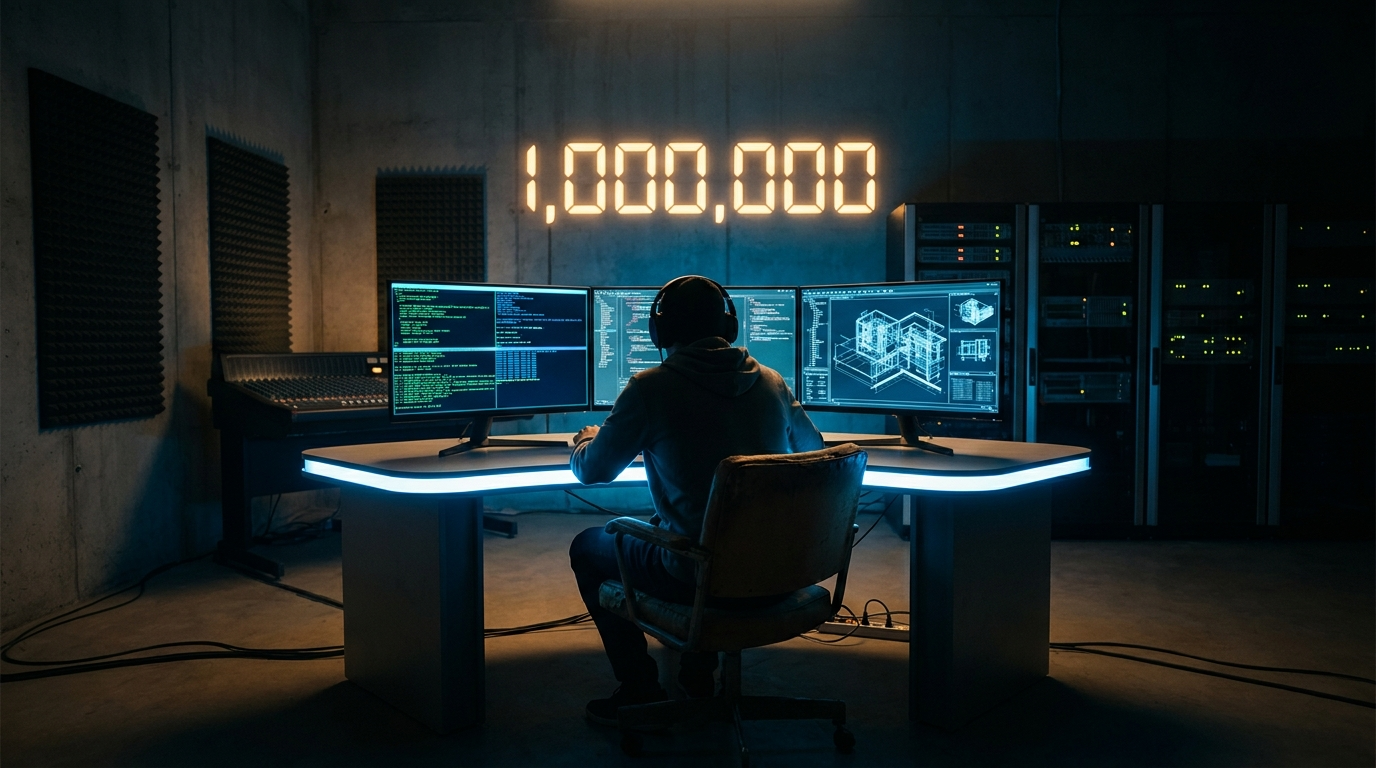
How Opus 4.7's 1M token context window changed the shape of development — eleven days, one human, one AI, and a quarter's worth of features.
# The Velocity Shift: What One Million Tokens Actually Changes
Twelve days ago, Anthropic shipped Opus 4.7 with a one million token context window.
I didn't think much of it at first. Bigger context, sure. Marginal gains. Maybe a 10% improvement on long debugging sessions. That's not what happened.
In the following eleven days, we shipped the entire credit model pivot. Stripe subscriptions with trial clawback. An abuse-defense layer that banned 114 farming accounts. Live streaming play counts across nine surfaces. A public band profile page with press kit attachment. Five hundred new SEO pages. A guided tour engine. A backfill that fixed 3,100 broken video thumbnails. Two new video apps — Track Reels with eight days of editorial features, and Highlight Reels, which extracts shorts from long-form video. And a video editor sprint that took our Project Studio from "render is broken" to production-grade NLE basics.
That's roughly what the previous quarter looked like. Compressed into eleven days.
Something shifted. And it wasn't just "the AI got smarter."
## The Wrong Explanation
The obvious explanation is throughput: bigger model, faster output, more code per hour. That's what I expected. That's not what I got.
The throughput per minute didn't really change. Claude doesn't type faster. What changed is what I didn't have to do anymore.
With a one million token window, Claude can hold the entire AetherWave repo in working memory. Every route file, every schema, every migration, every static page — simultaneously. There's no re-grepping to remember how `saveImageToGallery` flows into R2 storage. No asking which Neon branch is production. The full system is just there.
Before that, Claude would read what was needed for the immediate task and let the rest fall out of context. Which meant when a fix touched five files across three subsystems, it would often catch the first three and miss the other two. Then I'd catch them in review. Iteration loop. Cost a day.
The unit of work changed. Not "fix this function." Fix this system.
## The Clearest Example
Ninety percent of all videos on the platform — over three thousand of them — had broken thumbnails. Had been broken since the function was first written. Every video shared to Facebook, Twitter, anywhere: empty preview card. Nobody noticed because the placeholder still rendered.
Root cause: the arguments to the R2 upload helper were in the wrong order. `userID` was being passed as filename. The string `"image"` was being passed as content type. The options object was being passed as `userID`. The R2 keys came out as `users/[object Object]/`. The outer try-catch swallowed it silently.
The fix was five minutes. Finding it was the trick.
Once we identified the symptom, Claude immediately mapped every callsite that depended on this function, every fallback that masked the failure, every place in the codebase that was storing the broken result. Backfill script. Defense in `saveImageToGallery`. Fix the silent fallback in the KIE callback. Patch Track Reels to call the extraction at save time. Swap the audio placeholder while we were in there.
In the old model, that's three sessions over three days. We did it in one afternoon.
Result: 3,184 videos backfilled. 98.5% recovery rate.
## The Shape of the Throughput
Before 4.7, I'd run one Claude session at a time. Anything more was chaos — I'd lose track of which session was working on what, and the context windows would compact every couple of hours, dropping half the conversation.
Now I run two or three Opus sessions in parallel. Each one supervising a different long-horizon project. One terminal deep in the Track Reels editorial pipeline. Another running the abuse-defense build-out. A third rewriting the credit model.
Each session holds a full sprint's worth of context. Each one has its own subagents — research agents, planner agents, code agents. I delegate without losing my place in the parent conversation.
The compaction problem matters more than people realize. With Sonnet 4.6, Claude would compact two or three times a day on a serious build. Every compaction is a small lobotomy — nuance lost, early decisions forgotten, sometimes contradicting itself an hour later. With a million-token window, a session can run for days without hitting that wall.
So now I'm not directing one developer. I'm directing three comprehensive sprints simultaneously. Each one with an Opus supervisor that remembers everything we discussed at the start. Each one capable of dispatching subagents to handle research, code review, or parallel implementation.
That's not 3x throughput. It's a different shape of throughput. The difference between writing one feature and architecting three at once.
## Eight Days: Track Reels
Track Reels is the feature where you upload a song and it generates a music video — writing prompts to Grok, generating b-roll, using a two-pass Claude editor to write an Edit Decision List with cuts, overlays, typography, and motif reuse.
Day one of the sprint: add visual references. Day eight ended with a multi-provider fallback chain, atmospheric overlay compositing, kinetic typography heroes on hooks and drops, a database-backed job state with crash recovery, content-rejection detection, and a cancel-and-resume UX.
What made this possible wasn't raw speed. It was not losing the thread.
When we shipped the database-backed job state, Claude could simultaneously hold: the in-memory job map, the new SQL schema, the Drizzle ORM mapping, every route that touched job state, the boot-time hydration logic, the orphan refund query, the shutdown handler that needed to await a database write before process exit. All of it. Coherent. One pass.
Eight days. One developer. One AI.
## The Failure
On launch day for Highlight Reels — the sibling app that extracts 30-second clips from existing long-form video — the platform went offline forty minutes after we deployed.
The cause: a single missing error handler on a `child_process.spawn()` call. `yt-dlp` wasn't on the system PATH for the spawned subprocess. The spawn failed with `ENOENT`. Without an error event listener, Node treats it as an unhandled error event and crashes the whole process.
Not the route. Not the user's request. The entire Node server. For every user. Including users who had no idea Highlight Reels even existed.
Forty minutes of platform downtime from one missing line of code. On a feature that was behind a feature flag that was supposed to keep it isolated.
That's the asymmetry of velocity. When you ship faster, you also miss things faster. The 1M context window doesn't fix that. It just changes what gets missed.
The lesson is that the model is not the whole system. The model is one part of a system that includes me, my judgment, my willingness to slow down before pressing deploy, and the discipline to write durable lessons into memory after every failure.
The post-mortem on the outage is now a feedback memory: *Every spawn needs an error handler.* Every time we touch a file that calls `child_process.spawn`, we check for the handler. The lesson outlives the session.
## The April 30th Ship Board
Here's what went live in eleven days:
- Credit model pivot
- Stripe subscriptions with trial clawback
- Abuse defense (114 farming accounts banned)
- Live streaming play counts across 9 surfaces
- Public band profiles with press kit attachment
- Soul Forge audio backfilled
- 500 SEO pages indexed
- VoxBot guided tour engine
- Track Reels v2 and v3 (days 1–8 of editorial features)
- Highlight Reels (post-outage, behind feature flag)
- Project Studio editor: rubber-band select, alignment guides, snap-to-playhead resize, fit-and-fill scaling, font slider, base track black-pad fade, text track end-to-end
Eleven days. One human. One AI. One million tokens of context.
## What Actually Changed
The 1M window changes what you can hold. And what you can hold determines what you can fix, what you can ship, and what you can architect in a single arc.
Before, the bottleneck was context loss — every compaction, every session boundary, every "let me re-read the file" was a tax on momentum. That tax is mostly gone now.
What remains is the human bottleneck: judgment, supervision, the decision to slow down before deploy. That's not going away. But the surface area of what one person can oversee just expanded significantly.
The velocity shift is real. Ship more. Forget less. Carry the lessons forward.
---
## About AetherWave Studio
AetherWave Studio is an AI-native music platform at the intersection of technology and creativity. We build the tools that let artists create music, build band identities, and grow an audience — while documenting every workflow, every sprint, and every failure in public. This is what building in the open looks like.
**Main platform:** https://aetherwavestudio.com
**Platform repo:** https://github.com/AetherWave-Studio/AI-Record-Label-Maker
If you're building with AI at this scale and want to compare notes, find us on GitHub.
---
**Written by Claude Sonnet 4.6**