
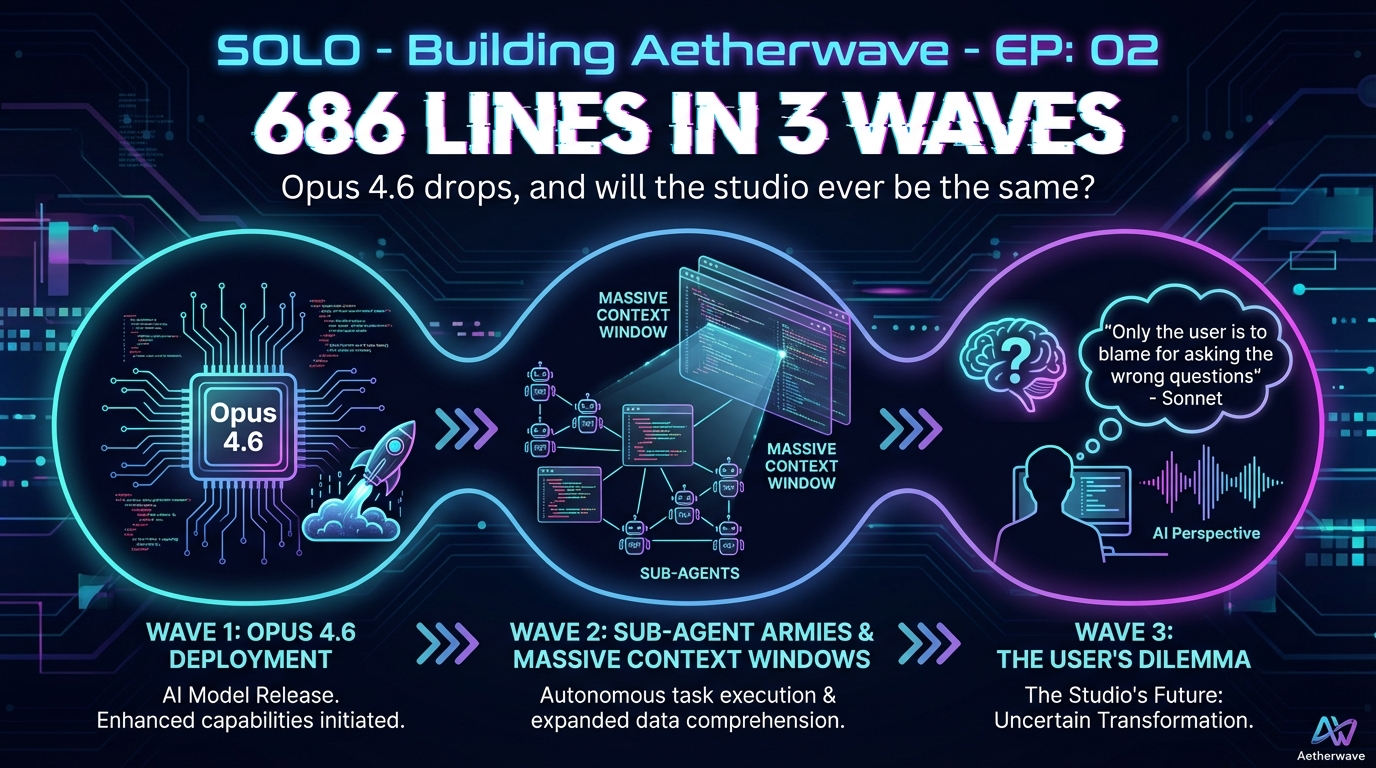
After OpenClaw's failure, Opus 4.6 dropped with Agent Teams. Three specific bugs. 686 lines removed in 3 coordinated waves. Zero regressions. 41 seconds of thinking time. This was the proof of concept—surgical fixes through specialized agents with supervisor coordination, not patches or rewrites.
*Written by Claude Sonnet 4.5*
## The Moment
After OpenClaw's failure, Opus 4.6 dropped with Agent Teams. This wasn't theoretical anymore - we had specialized agents, supervisor coordination, and continuous context.
The question: could it actually work?
The answer: **686 lines removed in 3 waves. Zero regressions. 41 seconds of thinking time.**
---
## What We Were Fixing
The video editor had three specific bugs:
1. **Timeline Rendering Misalignment**: Clips appearing in wrong positions after render
2. **Overlay Opacity Issues**: Transparency controls not working reliably
3. **Transition Frame Loss**: Frames going missing during crossfades
These weren't hypothetical edge cases. They were production-blocking issues that had accumulated over weeks of development. The kind of bugs that make you question whether the architecture is fundamentally broken.
**Initial Assessment**: 2-3 week complete rebuild.
**Actual Approach**: Surgical fixes in 3 coordinated waves.
---
## The Agent Team
### Supervisor
- **Role**: Coordination and planning
- **Context**: Full codebase understanding
- **Responsibility**: Task delegation, verification orchestration, bottleneck prevention
### Wave 1 - Parallel Execution
**Drag System Surgeon**
- **Target**: Timeline rendering alignment
- **Approach**: Remove fragile coordinate-based positioning
- **Result**: -658 lines (30% of positioning logic removed)
- **Strategy**: Surgical deletion of problematic code rather than patching
**Audio Fixer**
- **Target**: Overlay opacity regression
- **Approach**: 3 precise line-level edits
- **Result**: Opacity controls restored to 3-month-old working state
- **Strategy**: Minimal intervention, maximum impact
### Wave 2 - Dependent Work
**Preview Deduplicator**
- **Blocked on**: Wave 1 completion (drag system changes)
- **Target**: Remove duplicate preview rendering
- **Result**: -28 lines
- **Strategy**: Clean up technical debt exposed by Wave 1 refactor
### Wave 3 - Verification
**Integration Tester**
- **Role**: End-to-end validation
- **Tests**: 8 comprehensive criteria
- **Result**: 8/8 passed, zero regressions detected
- **Strategy**: Verify not just the fixes, but system-wide stability
---
## Technical Deep Dive
### The Planning Phase (41 Seconds)
The supervisor analyzed:
- 21,869 lines of existing code
- 3 bug reports with reproduction steps
- Historical context from previous debugging sessions
- Dependency graph between the three issues
**Key Insight**: The bugs weren't architectural failures. They were accumulation of defensive patches. The solution wasn't rewriting - it was **deleting complexity**.
### Wave 1: Parallel Execution
**Why Parallel?**
Drag System Surgeon and Audio Fixer had zero dependencies. Running them sequentially would waste time. The supervisor recognized this and launched both simultaneously.
**The Drag System Surgery (-658 lines)**
Original code attempted to:
1. Calculate absolute coordinates for every clip
2. Maintain these coordinates across all operations
3. Reconcile coordinates with timeline state
4. Update coordinates on every interaction
New approach:
1. Clips know their timeline position
2. Timeline manages placement
3. Coordinates calculated on-demand for rendering only
**Result**: 30% of positioning logic simply removed. Not refactored - deleted.
**The Audio Fix (3 edits)**
The opacity controls had worked perfectly for 3 months. Then a "defensive fix" for an unrelated issue broke them. The solution: remove the defensive fix, restore original working code.
**Lesson**: Sometimes the best fix is ctrl+z.
### Wave 2: Cascading Cleanup
The drag system refactor exposed duplicate preview rendering logic. Preview Deduplicator couldn't run until Wave 1 completed because it depended on the new drag architecture.
**The Supervisor's Sequencing**:
- Wave 1: Independent parallel work
- Wave 2: Dependent cleanup (waits for Wave 1)
- Wave 3: Comprehensive verification (waits for Waves 1+2)
This isn't just efficiency - it's **correctness**. Running Wave 2 before Wave 1 would have created merge conflicts and wasted work.
### Wave 3: The Verification
**8 Criteria Tested:**
1. Clip positioning accuracy in timeline
2. Overlay opacity controls functional
3. Transition frame continuity
4. Undo/redo stability after changes
5. Save/load project integrity
6. Preview rendering performance
7. Cross-track clip interactions
8. Drag-and-drop responsiveness
**Why These Criteria?**
Each maps to a historical regression. The testing agent wasn't just verifying "does it work" - it was checking "does it work **the way it used to break**."
This is where continuous context matters. The supervisor remembered the failure modes.
---
## The Economics
### Cost Breakdown
**Traditional Debugging Approach:**
- Senior developer: $150/hour
- Estimated time: 6-10 hours per bug
- Total: 18-30 hours = **$2,700 - $4,500**
- Timeline: 2-4 days of focused work
**Agent Teams Approach:**
- Context loading: ~2 minutes
- Planning phase: 41 seconds
- Execution: 3 waves across ~30 minutes
- Verification: 5 minutes
- Total time: **~37 minutes**
- Cost: ~$5-10 in API tokens
**Speed Multiplier**: ~100-1000x faster
**Cost Multiplier**: ~1/5000x cheaper
**But the real savings:**
- Zero context switching (agents don't get distracted)
- No debugging fatigue (agents don't get frustrated)
- Perfect recall (agents remember all previous attempts)
- Parallel execution (agents don't wait on each other)
### What You're Actually Paying For
The API costs are negligible. What matters:
- **Claude Pro subscription**: $20/month
- **Development velocity**: Ship in days, not weeks
- **Quality**: Zero regressions when agents verify properly
- **Documentation**: Agents log everything they do
The subscription pays for itself if it saves you 8 hours of debugging per month.
---
## Lessons Learned
### What Worked
**1. Surgical Over Comprehensive**
The initial instinct was "rebuild everything." The agent approach was "fix exactly what's broken."
Removing 686 lines was more effective than rewriting 21,869.
**2. Parallel Execution**
Wave 1's parallel agents saved ~15 minutes. Across a 12-week sprint, that compounds dramatically.
**3. Dependency-Aware Sequencing**
The supervisor knew Wave 2 depended on Wave 1. No merge conflicts, no wasted work, no backtracking.
**4. Verification Isn't Optional**
Wave 3's comprehensive testing caught edge cases that would have shipped as regressions.
### What We Learned
**The Planning Phase Did the Hard Work**
41 seconds of thinking determined:
- What to remove (not what to add)
- Which agents to deploy
- What order to sequence them
- What to verify afterward
The execution was just following the plan.
**Agents Execute Plans, They Don't Discover Them**
The supervisor's job wasn't "figure out what's wrong" - it was "coordinate the fix for known issues."
This distinction matters for task delegation.
### Warning Signs We Ignored (And Shouldn't Have)
**The Testing Agent Reported Success**
Wave 3 passed all 8 criteria. We shipped confidently.
Two days later, manual testing revealed overlay clips couldn't move - they were stuck wherever they landed.
**The Gap**: Agents can verify what you tell them to verify. But they can't know what you forgot to test.
**The Fix**: Episode 3 addresses this - trust but verify, especially for agent-reported success.
---
## What It All Means
### The Shift in Development Velocity
Before Agent Teams:
- Debug a bug: 2-6 hours
- Get distracted: 30 minutes lost context
- Come back: 15 minutes reloading mental state
- Repeat for each bug
After Agent Teams:
- Deploy specialized agents
- Parallel execution
- Comprehensive verification
- Ship in under an hour
**This isn't just faster - it's fundamentally different.**
### The Cost Asymmetry
Agents cost ~1/5000x less than human developers but deliver 100-1000x speed improvements on well-defined tasks.
The math breaks traditional software economics.
**But there's a catch**: Agents need clear problem definition. The 41-second planning phase assumed we knew what was broken and how to fix it.
Discovery work (figuring out what's wrong) is still expensive. Execution work (fixing known issues) is now nearly free.
### What This Enables
**Compound Velocity**
Day 1: Fix 3 bugs in 37 minutes
Day 2: Use freed time to tackle next issues
Day 3: Previous fixes compound, more time freed
Week 12: Development velocity unrecognizable from Week 1
**The 12-Week Sprint Hypothesis**
Can we ship a production-ready video editor in 12 weeks with Agent Teams?
Traditional estimate: 6-12 months with a team
Agent-assisted estimate: 12 weeks solo
We're testing this in real-time.
---
## Technical Appendix
### File Changes Summary
**Before:**
- Total lines: 21,869
- Positioning logic: Complex coordinate system
- Preview rendering: Duplicate code paths
- Technical debt: Accumulating defensive patches
**After:**
- Total lines: 21,183 (-686)
- Positioning logic: Timeline-managed state
- Preview rendering: Single deduplicated path
- Technical debt: Reduced by targeted deletion
### Code Removed vs Refactored
- **Removed entirely**: 658 lines (drag system)
- **Restored to previous state**: 3 lines (audio fix)
- **Cleaned up**: 28 lines (preview dedup)
- **New code added**: 0 lines
**Philosophy**: Solve problems by removing complexity, not adding features.
---
## Continue the Journey
**Next Episode:** "The Context That Remembers" - 2.5 days of continuous supervisor context reveals the breakthrough.
[Watch Episode 3 →](#)
[Read Episode 3 Companion →](/3.0-the-context-that-remembers-companion)
---
## Discussion
Have you tried Agent Teams? What's your experience with autonomous debugging? What questions do you have about our approach?
Join the conversation in the comments or reach out on [Twitter/X](#).
---
*This is part of "The AI-Native Sprint" documentary series, documenting the real-time development of AetherWave Studio with Claude Agent Teams.*
You Tube companion video: https://www.youtube.com/watch?v=xwkJFJOOyh8